
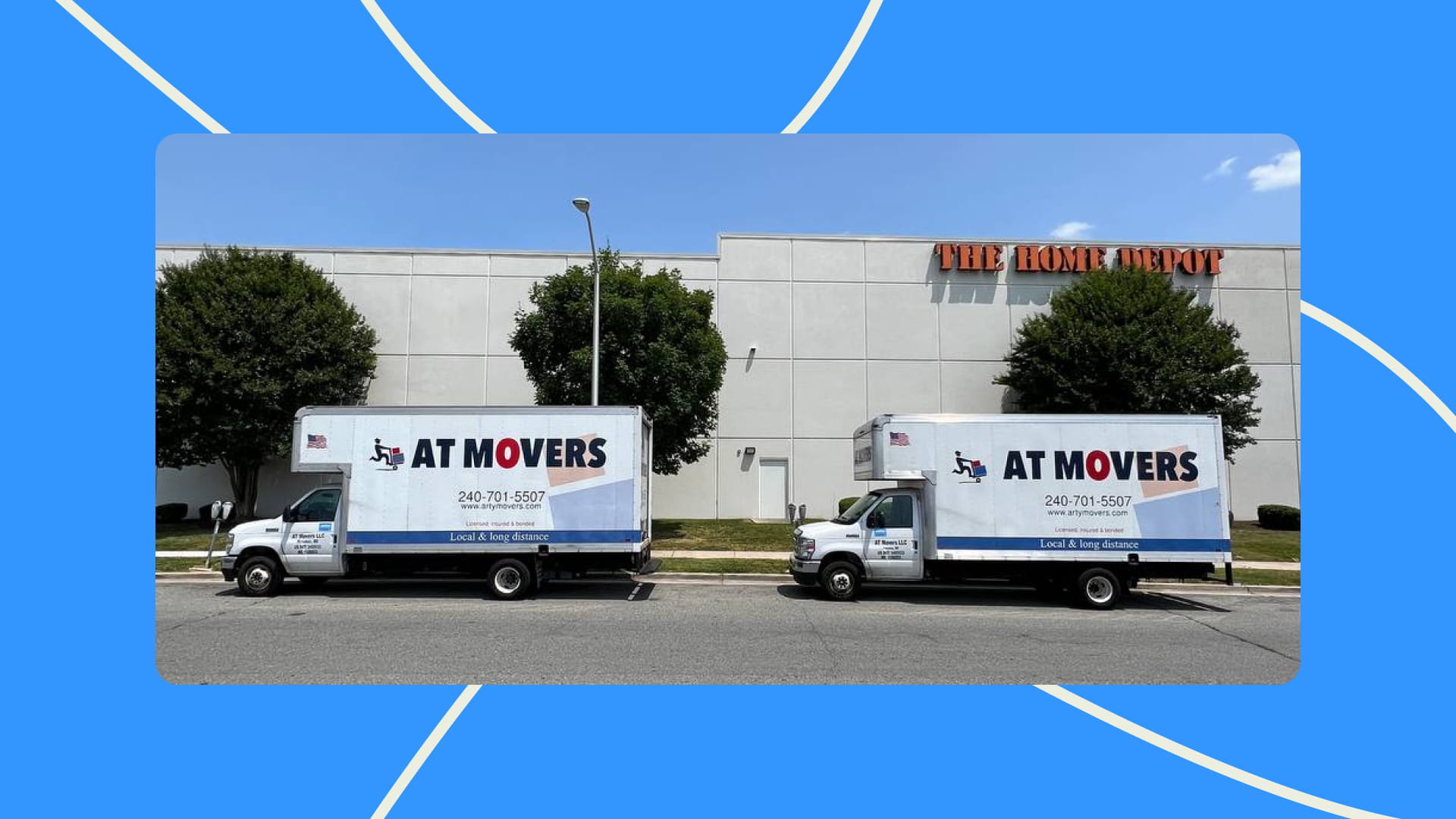

Many DC moves require reserved curb space for the moving truck in advance of the crew’s arrival. Especially if there is limited parking at the building, a long walk from the curb, stairs, elevators, loading dock rules or a strict move window. A DC moving truck parking permit reserves a space on the street for loading and unloading. It’s not a given. You still need to line up the right date, time window, truck space, posted signs and building requirements ahead of move day.
This guide covers how to reserve street parking for a moving truck in Washington, DC, what information you need before applying, how no-parking signs fit into the process, and what to do if the reserved space is blocked when movers arrive.
Generally, a DC moving truck parking permit is required to park a moving truck in curb space on a public street for loading or unloading. This is especially important for apartment moves, metered blocks, narrow streets, downtown addresses and buildings with elevator or loading dock rules.
What information you need before applying?
What information you need before applying
Before you start the permit request, collect the details the TOPS form asks for. This helps you avoid choosing the wrong curb space or submitting the wrong truck information.
- Move date: the date the truck needs the reserved curb space.
- Parking location: exact address, block, or intersection where the truck will stand.
- Location description: short note explaining where the truck will park, such as front curb, side street, alley, or loading entrance.
- Truck count: usually 1 moving truck for most apartment and house moves.
- Number of parking spaces: in this TOPS flow, use 4 spaces for 1 moving truck.
- Pickup and delivery addresses: check both addresses if the move starts and ends in DC.
- Building rules: elevator reservation, loading dock access, move window, and certificate of insurance requirements.
- Curb restrictions: fire hydrants, bus stops, driveways, loading zones, Metro entrances, bike share spaces, car share spaces, and street cleaning signs.
- Contact details: name, address, phone number, and email for the permittee section.
Check the permit fee before submitting
In this TOPS flow, the permit fee showed $55 for each moving truck. The final fee or deposit may change based on the final dimensions and other permit details.
How to Reserve Street Parking for a Moving Truck in DC. Step by Step
Getting a parking permit on your moving day in Washington, DC is simple. Follow these procedures to apply for and get permits from the DC government’s TOPS (Transportation Online Permitting System) website.
Step 1: Access the TOPS Website
Begin by visiting the DC government’s TOPS website at https://tops.ddot.dc.gov. This is the starting point for applying for your moving parking permit.
Step 2: Create an Account or Log In
If it’s your first time using the system, you’ll need to create an account. Click on the «Register» button and follow the prompts to set up your account. If you already have an account, simply log in.
When registering, the first step is to choose the «Type of Applicant». Select «Individual». If your business is moving, select the appropriate option.
After that, you fill out your personal information on the TOPS website
Step 3: Apply for a Public Space Permit
Once you have registered, log in. You will be taken to your account page. Look for the option to apply for a «Parking/Occupancy Permit» and select it. This category covers parking permits for moving trucks.
Then click on the green «Apply for Parking Signs/Temporary Occupancy Permits» link at the top of the page content. On the next page, click on the gray «Moving Truck» button.
Step 4: Fill Out the Application Form
1. Enter the moving truck parking location
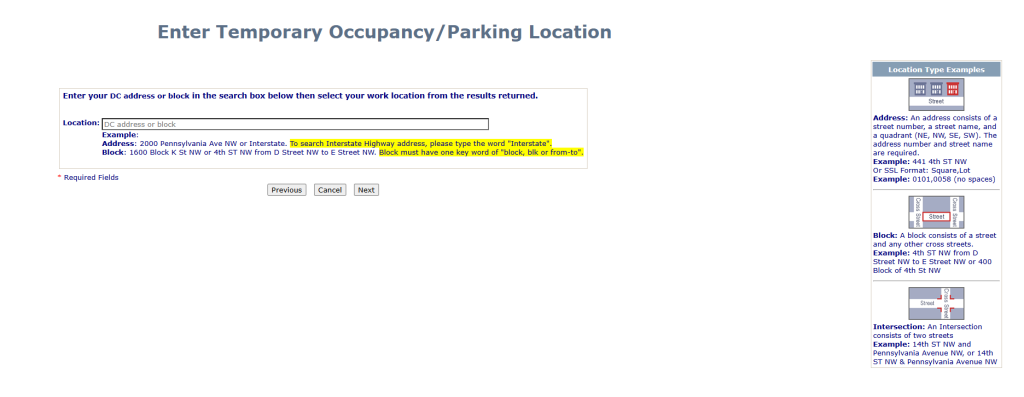
On this stage, enter the DC location where the moving truck needs to park. Use the Location field.
If the truck should park in front of one building, type the full street address. Example: 441 4th St NW.
If the truck needs space along part of a street, use a block format. Example: 400 block 4th St NW or 4th St NW from D St NW to E St NW.
If the space is near a corner, you can use an intersection. Example: 14th St NW and Pennsylvania Ave NW.
Choose the spot where the truck will actually load
For apartments, this may not be the main entrance. Use the loading dock, service entrance, alley, or side street if that is where the building requires movers to work.
After entering the location, choose the correct result from the list and click Next.
Check the street name, quadrant, and block before continuing. In DC, entering the wrong quadrant or nearby block can reserve space in the wrong place.
2. Describe the exact parking spot and number of trucks
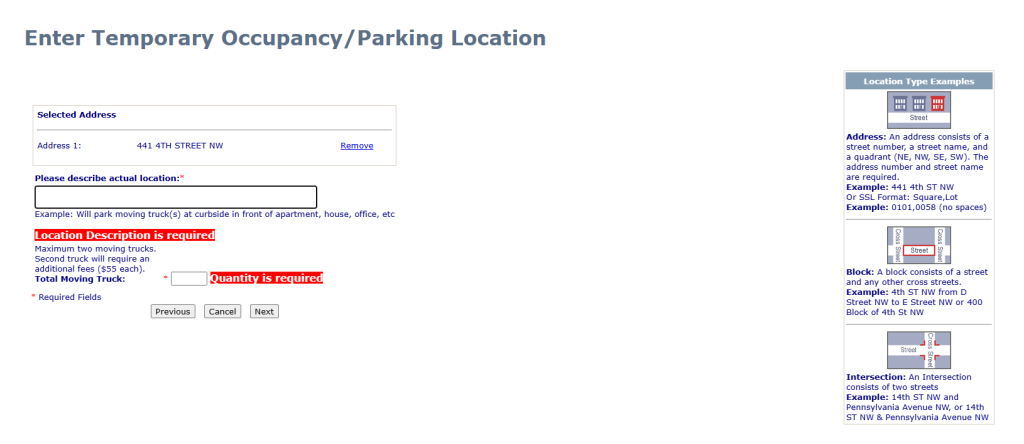
After you select the address, TOPS will show it at the top of the page. Check that the street name, quadrant, and address are correct. If the address is wrong, click Remove and choose the location again.
In the Please describe actual location field, write where the moving truck will stand. Keep it simple and specific.
Good examples:
- Moving truck will park curbside in front of apartment building.
- Moving truck will park curbside in front of house for loading.
- Moving truck will park by the building loading entrance on 4th Street NW.
- Moving truck will park in the alley behind the building for unloading.
Do not write only “apartment” or “moving.” The city needs to know where the truck will actually park: front curb, side street, alley, loading dock, or service entrance.
In the Total Moving Truck field, enter the number of trucks your move will use. For most apartment and house moves, enter 1. Enter 2 only if your moving company confirmed that two trucks are needed.
The form says the maximum is two moving trucks. It also notes that a second truck requires an additional fee ($55 for each truck). After entering the truck quantity, click Next.
3. Select the permit dates

On this stag, choose the dates when the moving truck needs the reserved curb space.
If you need parking for one moving day, select that move date as the Start Date and the End Date.
If the truck needs reserved space for more than one day, choose the first day as the Start Date and the last day as the End Date.
The form says the date cannot be changed after you submit the application. It also says you cannot change the location after the next page. Check the address and dates before clicking Next.
This is a 24-hour occupancy permit. Match the permit date to the day your movers actually need the truck space, not just your lease start date or building move-in date.
4. Choose the parking or occupancy type
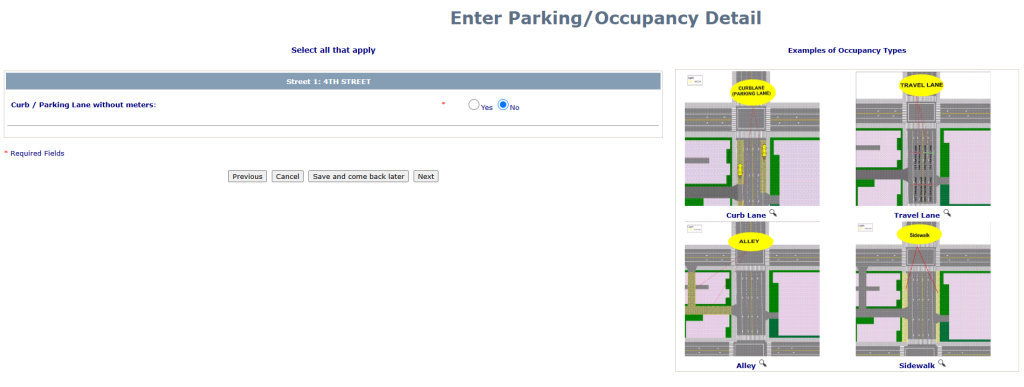
This stage asks what part of the street the moving truck will use.
If the truck will park at the curb on this street, choose Yes for Curb / Parking Lane without meters.
Do not choose No unless the truck will not use the street curb at all. If you choose No, TOPS may stop you with an error because no parking space has been selected.
“No” means you are not selecting the curb space
On this screen, No does not mean “no meters.” It means you are not using that curb or parking lane. For a normal moving truck parked on the street, choose Yes.
If the curb where the truck will park has meters, do not continue until you confirm that you selected the right location and permit type. The option shown here is for a curb or parking lane without meters.
After selecting Yes, click Next.
If you are not sure what your street looks like, use Google Maps and Street View.
5. Enter the number of parking spaces
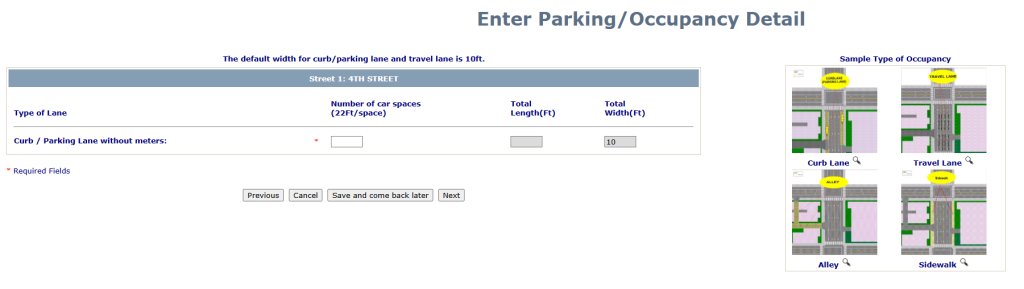
This stage asks how many non-metered curbside parking spaces you want to reserve for the moving truck.
For 1 moving truck, enter 4 in the Number of car spaces field.
In this TOPS flow, the form requires at least 4 spaces for 1 moving truck. So for a standard one-truck move, 4 is the value to use.
TOPS counts each parking space as 22 ft. Four spaces gives a total reserved length of 88 ft.
If your mover says the truck needs more than 88 ft of curb space, do not guess or force the form. You may need a second parking permit.
After entering 4, click Next.
6. Check curb restrictions
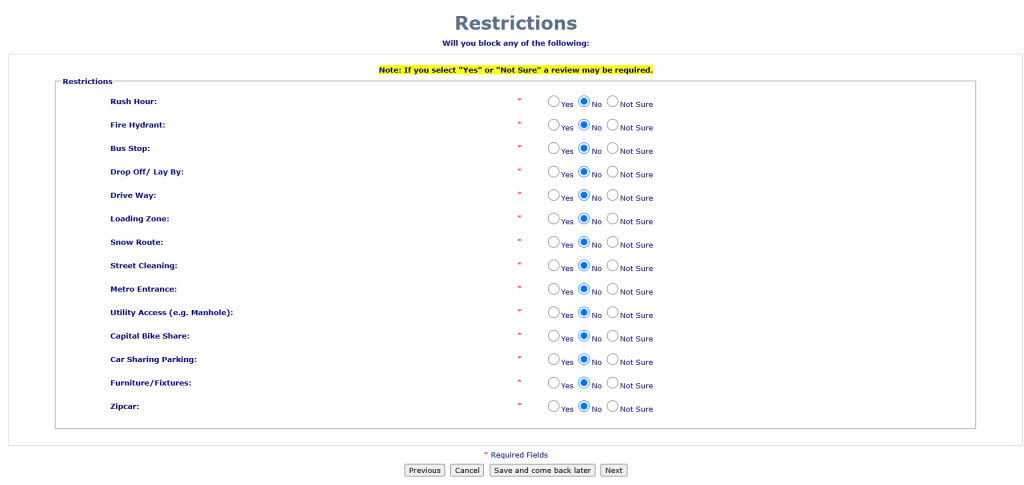
This stage asks if the reserved space will block anything important on the street.
Choose No only if the moving truck will not block that item. This includes fire hydrants, bus stops, driveways, loading zones, Metro entrances, bike share stations, car share spaces, and Zipcar spaces.
Choose Yes if the truck will block one of these items. Choose Not Sure if you cannot confirm it.
7. Review the estimated permit fee
TOPS will show an estimated permit fee before the final contact details stage.
Check the fee summary, then click Next. The page notes that the final fee or deposit may change based on the final dimensions and other permit details.
8. Confirm permittee and owner information
Next, confirm your contact details in the Permittee Information section. If you are logged in and the information is already correct, you can use Same as current user.
Leave Owner Information blank unless you are applying for another person or need to list a different owner.
If you fill in any Owner Information field, TOPS may require all owner fields. If you do not need this section, leave it empty.
Before submitting, review the notice at the bottom. Once the permit request is finalized, it may not be editable.
Step 5: Submit Application and Pay Fees
After completing the form, submit your application. Within one or tow business days your appeal should be considered. You will be contacted and you will have to pay the fee.
Step 6: How to print and post emergency no-parking signs
After your application is approved and the fee is paid, TOPS will let you print the permit and parking signs.
Do not plan to print the “No Parking” or “Reserved Parking” signs at home. DDOT says public space permits and signs can be printed at DDOT kiosks.
Where to print DDOT parking signs
DDOT lists two kiosks on the second floor of 1100 4th Street SW, just outside the Permit Center. DDOT also lists kiosks at the main MPD district stations below.
| Kiosk location | Address | Phone |
|---|---|---|
| DDOT Permit Center | 1100 4th Street SW, 2nd Floor | Check TOPS before visiting |
| First District Station | 101 M Street SW | (202) 698-0555 |
| Second District Station | 3320 Idaho Ave NW | (202) 715-7300 |
| Third District Station | 1620 V Street NW | (202) 673-6815 |
| Fourth District Station | 6001 Georgia Ave NW | (202) 715-7400 |
| Fifth District Station | 1805 Bladensburg Road NE | (202) 698-0150 |
| Sixth District Station | 100 42nd Street NE | (202) 698-0880 |
| Seventh District Station | 2455 Alabama Ave SE | (202) 698-1500 |
Check TOPS before going to a kiosk. Kiosk access, office hours, or station availability can change.
What to check before posting signs
- Permit number
- Approved address or block
- Move date
- Reserved parking window
- Number of spaces
- Correct side of the street
Post the signs at the exact curb space where the moving truck needs to park. After posting, take photos of the signs and curb area. Check the space again before the movers arrive.
When to apply for a DC moving truck parking permit
If you can, don’t wait until the last minute. A parking permit for a moving truck is available based on the move date, truck space, location, signs and the approval process. If even one detail is off, the moving crew may arrive and find no usable curb space.
Apartment moves need extra timing control
Other DC apartment buildings require elevator reservations, loading dock windows, move-in forms and a certificate of insurance. These items should correspond to the same time window as the parking reservation.
For same day or urgent moves, always check the official DDOT TOPS system first. If the permit can’t be completed in time, tell your movers before they show up. They may have to plan for a smaller truck, a different loading position, a longer carry, or a new arrival window.
Do not publish a specific application deadline or sign-posting deadline unless validated within the current DDOT TOPS process. The official timing can be modified.
Confirm truck size and count before applying
Before you start the permit request, confirm how many trucks or containers will need curb space. This is more important than guessing the truck size.
If you are hiring movers, ask how many moving trucks they plan to send. For most apartment and house moves, this is usually 1 moving truck.
Use the TOPS rule for moving trucks
In the TOPS moving truck flow, 1 moving truck requires 4 non-metered parking spaces. TOPS counts each space as 22 ft, so 4 spaces equals 88 ft of reserved curb length.
In the same TOPS flow, the form allows a maximum of 2 moving trucks. The fee shown in the form was $55 per truck, so 2 trucks would show as $110. Check the live fee screen before paying because permit fees can change.
If you are renting a moving truck
If you rent and drive your own truck, use your rental reservation to confirm the truck size. Do not use the rental size to reduce the TOPS parking-space number. In this TOPS flow, one moving truck still uses 4 spaces.
| Rental option | Common sizes listed by provider | What to do in TOPS |
|---|---|---|
| U-Haul moving trucks | 10 ft, 15 ft, 20 ft, 26 ft | Enter the truck count. For 1 truck, use 4 spaces in this moving truck flow. |
| Penske trucks and vans | Cargo van, 12 ft, 16 ft, 22 ft, 26 ft | Enter the truck count. For 1 truck, use 4 spaces in this moving truck flow. |
Do not assume one 22 ft “car space” is enough because your truck is short. TOPS require 4 spaces for one moving truck even when the truck itself is shorter than 88 ft.
If you are using PODS, U-Box, or another portable container
A portable container is different from a moving truck. A truck comes, loads or unloads, and leaves. A container may stay in place for hours or days.
If the container will sit on a private driveway or private property, the DC moving truck parking permit flow usually is not the right permit path because the container is not occupying public curb space.
If the container will sit on a DC street, curb lane, sidewalk, alley, or other public space, treat it as a DDOT public space permit issue. Do not use the moving truck permit steps above without checking the correct TOPS permit type for container placement.
| Container option | Sizes or capacity listed by provider | How to handle DC public space |
|---|---|---|
| PODS | 8 ft, 12 ft, 16 ft containers | If placed on a DC street, curb lane, sidewalk, alley, or other public space, use DDOT TOPS to find the correct public space permit path. |
| U-Box | One container fits about a room and a half of household items | If delivered to DC public space, use DDOT TOPS to find the correct public space permit path before the delivery date. |
Do not treat a PODS or U-Box container as a normal moving truck permit. If it will stay in public space, the permit needs to match the container placement, location, and dates.
What to do if cars are parked in your reserved moving space
If there are cars in the reserved moving space, report the problem first. Photograph the posted signs, permit information, the blocked curb space, and the vehicles parked there.
Then contact the enforcement channel listed in your permit instructions or the proper DC service channel. Do it as quickly as possible. Don’t wait until the truck is at the building.
Let your movers know immediately. A blocked space can change the moving plan. The crew may have to park further away, wait for access, use a different entrance or re-order loading.
Don’t assume towing or enforcement is guaranteed. Even with a permit and signs posted, a blocked curb space can still mean delays, long carries, or extra walking time.
How parking affects the final moving cost
Local moves are often based on time, access, and walking distance so parking may also have an impact on the final moving cost. If the truck cannot park near the entrance, movers may need more time to move items from the building to the truck.
Reserved curb space helps control moving time
Long carry, parking far from the entrance, double parking, waiting for a blocked curb space, and missing part of an elevator or loading dock window are the biggest parking-related cost risks.
Reserved curb space doesn’t eliminate all delay, but it removes one of the most common moving-day problems in DC. For a more detailed breakdown of what goes into the final bill, see our DC moving cost guide.
Navigating Common Challenges in DC
- Narrow Streets: DC’s neighborhoods often feature narrow streets that can be difficult for larger trucks to navigate. When possible, opt for a smaller truck that can maneuver these areas more easily.
- Busy Areas: Moving in or out of areas like Capitol Hill or downtown can be tricky, especially during peak hours. Plan your move during off-peak times to minimize traffic congestion and ease the process of loading and unloading.
- Height Restrictions: Some residential areas and apartment complexes have height restrictions for vehicles. Verify these restrictions to ensure the moving truck can access your property without issues.
- Communicate with Your Moving Company: Most professional DC moving companies are well-versed in truck parking issues. While they often don’t handle the process of obtaining parking permits directly, they can advise you on all related matters.
Parking details can change the moving plan
Let AT Movers know the pickup address, delivery address, building rules, stairs, elevator access and parking situation before move day. These details assist in planning the truck, arrival window and loading setup.
One more thing before the FAQ: the TOPS process above only covers the District. In the Maryland suburbs the rules are run by each city. Rockville, for example, posts temporary no-parking signs through its police department and wants at least five business days of notice, a process we walk through on our Rockville movers page. And if your move starts or ends inside the District itself, our DC movers team handles the permit timing as part of the plan.
FAQ
You may need one if the truck is reserving curb space on a public street for loading or unloading. It is especially important for apartments, metered blocks, narrow streets and areas with limited parking.
Submit your application as soon as you know the move date, truck size and time window. Don’t wait until the last minute. If you want to post a fixed deadline, check current timing in DDOT TOPS first.
Some movers might guide you but most of the time the customer will have to give address details, building rules and permit information. But ask your moving company if they can handle that before assuming they will get the permit.
Take pictures of the signs, the permit info, and the blocked-off area. Inform your movers early and contact the enforcement channel listed in your permit instructions. Enforcement or towing is not assured.
Parking may be required at one or both locations. Check the pickup and drop off spots individually. A permit for one address does not apply to the other address.
No, a parking permit is for curb space. The building accepts elevator reservations, loading dock access, move-in forms and certificate of insurance requests.
It can help control cost by reducing walking distance, waiting time and loading delay. There’s no guarantee that the final price will be lower as the move size, access, stairs, elevator time and crew size also come into play.
Yes, but it is riskier when parking is limited or the building has strict move rules. Without reserved space at the curb, the truck may have to park farther away, adding time to the move.


